




New Zealand has taken another major step towards a regulated online casino market, with expressions of interest for up to 15 iGaming licences set to open in July as the country prepares for a fully licensed regime in 2027.

New Zealand’s Department of Internal Affairs is leading the implementation of the country’s new online casino gambling framework.
New Zealand’s long-awaited online casino licensing regime is moving into its next major phase, with the government preparing to open expressions of interest for operators seeking one of the country’s limited iGaming licences. The process marks a significant turning point for a market that has historically seen New Zealand players access offshore online casino sites without a domestic licensing system in place.
Under the new framework, up to 15 online casino gambling licences will be made available. The Department of Internal Affairs will oversee the process, which begins with expressions of interest in July, followed by an auction phase and then full licence applications later in the year.
The move is designed to bring online casino gambling under stronger domestic control, with a clear focus on consumer protection, harm minimisation, compliance, responsible advertising and market integrity. For operators, it also begins a competitive race for access to one of the most closely watched emerging regulated iGaming markets in the Asia-Pacific region.
Highlight: New Zealand is not opening its online casino market freely. It is creating a capped, controlled and competitive licensing model, with only up to 15 licences available.
A Three-Stage Licensing Process
The licensing process will unfold in three key stages. First, operators will be invited to submit an expression of interest. That stage is scheduled to open on 17 July 2026, with submissions due by 14 August. Only providers with an accepted expression of interest will be able to move forward to the next stage.
The second stage will be an auction, expected in September. This will determine which eligible providers gain the right to apply for a licence. The third stage, expected to open in October, will require successful bidders to submit full licence applications, including detailed plans around advertising, marketing, consumer protection, harm prevention, operational compliance and business structure.
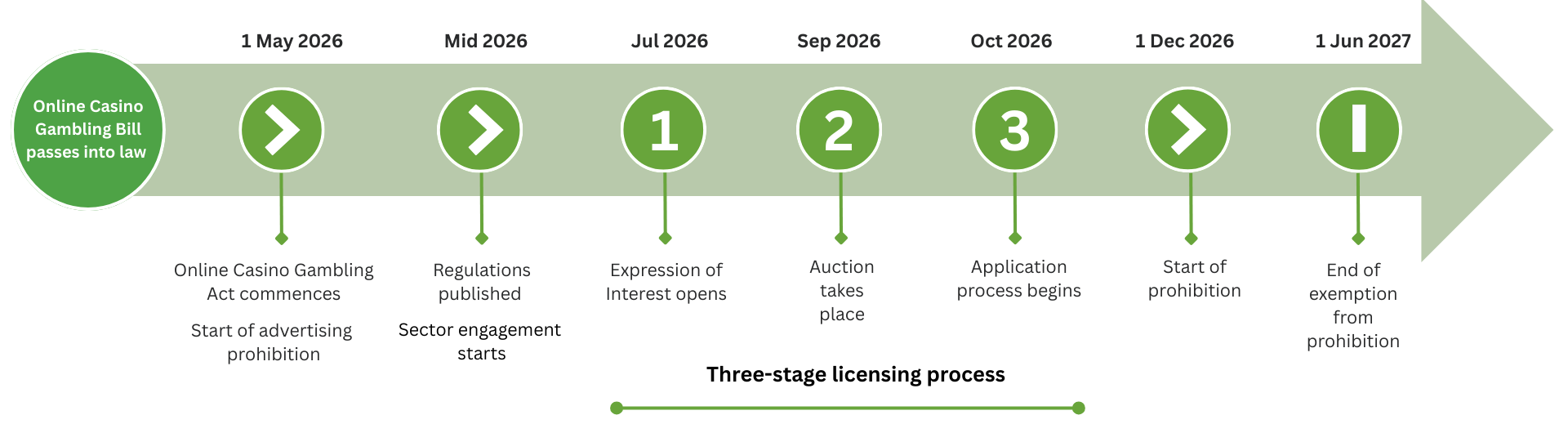
The Department of Internal Affairs’ indicative timeline shows the phased path towards New Zealand’s regulated online casino market.
The system has been designed to give regulators time to assess suitability before the market becomes fully operational. This is not simply a case of operators paying for access. Applicants will need to show they are financially sound, operationally credible and able to comply with New Zealand’s rules.
What to watch: The auction stage could become one of the most important moments in the process, as major international operators decide how much a New Zealand licence is worth.
Why New Zealand Is Regulating Online Casino Gambling
Online casino gambling is not new to New Zealand consumers. For years, players have been able to access offshore websites, while local online casino operators have not been permitted to offer domestic services under a full New Zealand licensing model.
That created a grey-market environment. Players could gamble online, but much of that activity sat outside New Zealand’s direct regulatory control. The new framework aims to change that by channelling activity towards licensed platforms that are subject to local rules.
For the government, the priorities are clear: reduce gambling harm, improve player protection, prevent crime and dishonesty, control advertising and ensure that operators serving New Zealand customers meet domestic standards. The framework also creates a pathway for online casino revenue to contribute more directly to tax and community funding structures.

New Zealand’s online casino reforms have moved through Parliament and are now being implemented by the Department of Internal Affairs. Image: Wikimedia Commons / Ulrich Lange.
The introduction of a capped licence system also gives New Zealand more control over the shape of its market. Rather than allowing unlimited participation, the government is restricting access to a limited group of approved operators. That could create a more manageable regulatory environment, but it also raises questions about competition, pricing, consumer choice and channelisation.
The December Deadline
One of the most important dates in the timetable is 1 December 2026. From that point, providers that have not applied for a licence will be required to stop conducting online casino gambling in New Zealand. Operators that have submitted an application may be allowed to continue operating while their application is assessed, but they will not be permitted to advertise during that period.
This deadline gives existing operators a clear decision point. They must either enter the licensing process, prepare to leave the market, or risk enforcement action. For companies already serving New Zealand customers, the coming months will be critical.
The advertising rules are also significant. During the transition period, online casino advertising remains prohibited. Once the licensed regime is in place, approved operators will be allowed to advertise only within the rules set by the regulatory framework.
Market angle: The December deadline gives the new regime real force. Operators cannot simply wait and see, they must either apply, comply or exit.
What Licensed Operators Will Need to Prove
Successful applicants will need to demonstrate more than commercial ambition. They will need to show that they can operate responsibly in a regulated market. That includes systems for harm minimisation, consumer protection, record-keeping, advertising controls, complaints handling and compliance monitoring.
Operators will also need to be ready for ongoing oversight. A licence will not be a one-off approval, but an active regulatory relationship. The Department of Internal Affairs has made clear that compliance history may be considered, meaning operators already active in the market will need to pay close attention to their conduct during the transition period.
Each licence will be linked to a single brand, and no one provider will be able to hold more than three licences. This prevents excessive concentration and ensures that the capped market is not dominated entirely by one or two large groups.
A Regulated Market With International Interest
New Zealand may not be the largest iGaming market in the world, but the limited licence model will likely attract serious international attention. Global operators often view tightly regulated markets as strategically valuable, particularly when they offer legal certainty and a clear path to long-term participation.
However, the cap on licences means not every interested operator will succeed. The combination of an expression-of-interest process, auction and full licence application creates a competitive funnel. Operators will need to decide whether the cost of participation, compliance expectations and licence term justify the investment.
For established brands, the appeal is obvious. A regulated New Zealand licence offers market legitimacy, advertising permission once approved, and access to consumers within a framework that may gradually shift players away from unlicensed sites.
For regulators, the challenge will be channelisation. A successful regime will depend not only on licensing strong operators, but also on ensuring players choose licensed sites over offshore alternatives.
Industry angle: The success of New Zealand’s iGaming model will depend on whether licensed operators can attract players away from the grey market while maintaining strong consumer safeguards.
Community Funding and Player Protection
A central part of the policy debate has been how online casino gambling should contribute to New Zealand communities. The government has positioned the new regime as a way to ensure revenue from online gambling is captured more effectively, with licensed operators contributing through duties, levies and community funding expectations.
That balance is important. Online casino regulation can generate revenue, but it also carries social responsibility concerns. Stronger rules around advertising, harm prevention and customer protection will be essential if the framework is to maintain public confidence.
The system is expected to place licensed operators under clear obligations, including responsible gambling controls and consumer protection requirements. For players, the intended benefit is a safer environment with clearer accountability. For government, the benefit is stronger visibility over a sector that previously operated largely beyond direct domestic licensing.
The Bottom Line
New Zealand’s iGaming licensing timeline marks a major step towards a regulated online casino market. With expressions of interest opening in July, an auction expected in September, full applications due later in the year and key restrictions taking effect from 1 December, the country is moving quickly from policy design to practical implementation.
The limited 15-licence model creates opportunity, but also pressure. Operators that want access to the market must move quickly, prepare detailed submissions and demonstrate that they can meet New Zealand’s compliance expectations.
For players, the shift should mean a safer and more transparent online casino environment. For operators, it is the start of a competitive race for a scarce licence. For New Zealand, it is an attempt to bring offshore digital gambling activity into a controlled, taxable and more accountable domestic framework.
If delivered effectively, the new regime could become one of the most closely studied iGaming models in the region, a capped market designed to balance commercial opportunity with consumer protection and public trust.