


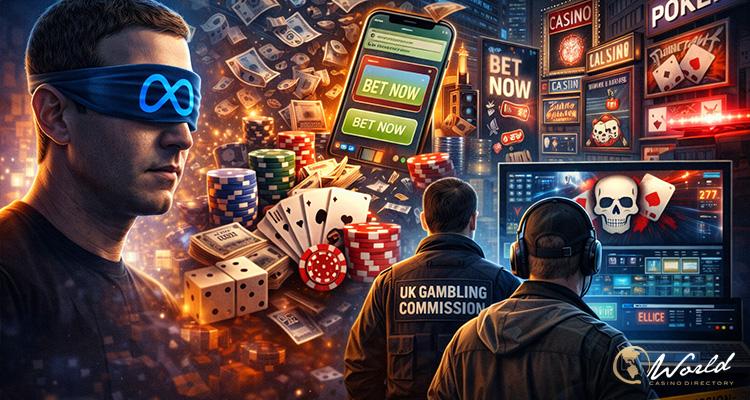
There is a quiet but increasingly consequential shift taking place across the UK’s iGaming landscape. It is not defined by innovation, product development or even regulation alone, but by something more structural: who is actually winning the battle for visibility. At first glance, the numbers appear reassuring. Advertising spend from licensed UK operators is falling, not rising, and a growing share of that spend is directed towards safer gambling messaging. But beneath that surface sits a more complex and less comfortable reality. As the regulated market pulls back, the unregulated one is accelerating, creating a narrowing gap that now raises a serious question: what happens when the black market begins to rival, or even surpass, the legal sector’s share of voice?
A Shrinking Presence from the Regulated Market
Recent analysis commissioned by the Betting and Gaming Council paints a clear picture of contraction. Licensed gambling advertising accounted for just 2.7% of the UK’s total ad market in 2024, down from 3% the previous year, with total spend reaching around £1.15 billion across advertising and sponsorship. The trajectory, however, is what matters. Since 2021, spend has been declining at an annual rate of approximately 1.7%, driven in part by a £30 million reduction in television advertising. This is not simply cost-cutting; it reflects a broader shift in regulatory pressure and public scrutiny, with around 20% of all licensed gambling advertising now dedicated to safer gambling messaging, embedding compliance and consumer protection directly into marketing strategy. From a regulatory standpoint, the system is functioning effectively, with fewer than 0.02% of adverts subject to rulings from the Advertising Standards Authority, yet effectiveness in regulation does not necessarily translate into dominance in reach.
The Rise of the Unregulated Challenger

While licensed operators are becoming more restrained, illegal platforms are moving in the opposite direction. Estimates suggest that black market gambling sites are now spending between £500 million and £700 million annually on advertising, but this is not just a matter of scale, it is a matter of approach. Unlicensed operators are not bound by UK advertising standards, age verification requirements or responsible gambling frameworks, and instead exploit the full spectrum of modern digital marketing, from influencer partnerships and affiliate networks to aggressive search placement and AI-generated content designed to mimic legitimate brands. In some cases, these operators have gone further, impersonating trusted institutions or charities to build credibility with users. The contrast is stark. One side is becoming more compliant, more cautious and more constrained, while the other is becoming more visible, more agile and more aggressive.
The Tipping Point: Advertising Share vs Market Control
What makes this moment significant is not just the growth of the black market, but the relative positioning between the two. If licensed operators are spending around £1.15 billion while illegal operators are approaching up to £700 million, the gap is no longer vast, and more importantly, the effectiveness of that spend differs. Licensed advertising is constrained by compliance rules, time restrictions and messaging requirements, whereas illegal advertising can appear anywhere, target anyone and say anything. That asymmetry creates a disproportionate impact, where a smaller but unrestricted budget can compete far more effectively than a larger but regulated one. The consequence is a potential inversion of visibility, not necessarily in total spend, but in influence.
A Structural Risk to Consumer Protection
This is where the issue moves beyond market dynamics and into something more serious. The regulated UK gambling sector is built around safeguards such as age checks, deposit limits and self-exclusion schemes, yet illegal operators remove all of them. As the Betting and Gaming Council has warned, these platforms operate with no safeguards, no age checks and no consumer protections, creating a materially higher risk environment for users. The paradox is difficult to ignore. The more the regulated market tightens its standards and reduces its visibility, the more space is created for operators who offer none of those protections.
The Strategic Dilemma for the Industry
At the heart of this issue sits a tension the industry has yet to resolve. Reducing advertising aligns with political pressure, public sentiment and responsible gambling objectives, but it also weakens the ability of licensed operators to compete for attention in an increasingly crowded and unregulated digital ecosystem. The question is no longer simply whether gambling advertising should be reduced, but whether reducing it without addressing the black market creates unintended consequences. There is growing recognition that the conversation must evolve, not just around how much advertising exists, but around who is doing it, under what rules, and with what level of accountability.
A Market Redefined by Visibility
The UK iGaming sector is entering a phase where visibility may matter as much as regulation. Licensed operators remain compliant, structured and economically significant, but compliance alone does not guarantee relevance. If current trends continue, the industry may find itself in a position where the loudest voices are no longer the safest ones, and in a market defined by digital reach, that shift could prove decisive.